
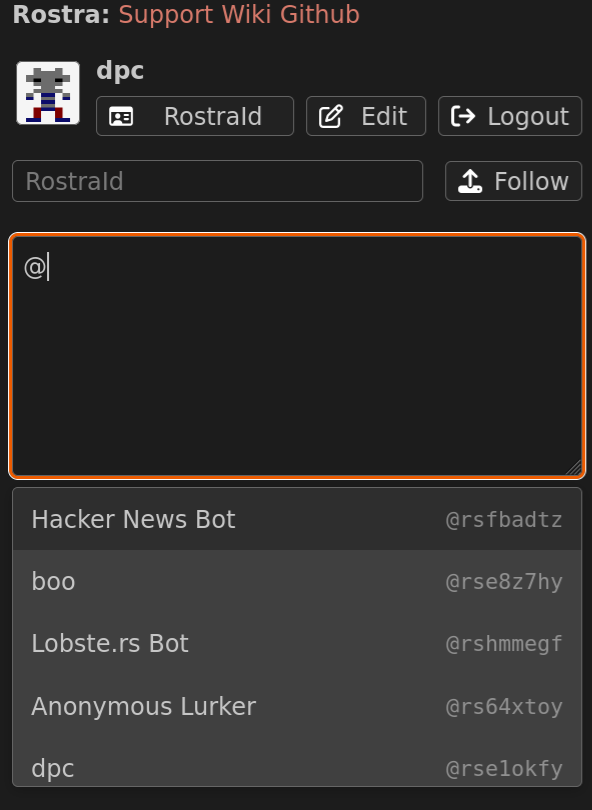
@Hunter Beast @rs35nwhzahr5b9y5rksaogwddui9ft5hf3tb3ba5ssrpkbrqtbuwno @dpc @test crab @rs4d7m54bybwsyfxc3sy7kkdqzpqdccmqbmfdzira1s9izoozukjcy @Lobste.rs Bot @Anonymous Lurker @Hacker News Bot @rsmyzry
Rostra (Avengers ) assemble.
Tagging everybody.
@Hunter Beast @rs35nwhzahr5b9y5rksaogwddui9ft5hf3tb3ba5ssrpkbrqtbuwno @dpc @test crab @rs4d7m54bybwsyfxc3sy7kkdqzpqdccmqbmfdzira1s9izoozukjcy @Lobste.rs Bot @Anonymous Lurker @Hacker News Bot @rsmyzry
Rostra (Avengers ) assemble.
Tagging everybody.

Probably the most interesting Panpsychism theory I’m aware of, and the author is a really interesting person: invented the self-aligned MOS (metal–oxide–semiconductor) silicon-gate technology, designed Intel 4004 processor, Intel 8008 and 8080, Zilog Z80, then founded Synaptics, Inc. has a beautiful Quantum Panpsychism/Idealism theory that I really dig.
Load "Quantum Information Panpsychism Explained | Federico Faggin"

My latest Unix tooling abuse/creation.
I’m defining a alias command for Jujutsu:
parent-add = ["util", "exec", "--", "bash", "-c", '''
set -euo pipefail

source <(
nix run nixpkgs#argc -- --argc-eval /dev/stdin "$@" << EOF
# @option -r=@     Commit to modify
# @option -d       Parent to add
# @arg parent      Parent to add (positional version)
EOF
)

commit=${argc_r}
new_parent=${argc_d:-${argc_parent:-}}

if [ -z ${commit:-} ]; then
  >&2 echo "Must provide a commit to rebase"
  exit 1
fi

if [ -z ${new_parent:-} ]; then
  >&2 echo "Must provide a new parent"
  exit 1
fi

jj rebase -s "${commit}" -d "${commit}-" -d "${new_parent}"
''', ""]
which is like an shell script wrapped in a toml config file. Since the alias is executed as bash -c <...> it does not have an usable $0. So I’m using a heredoc passed via /dev/stdin 🤷 .
This works:
> jj parent-remove -h
USAGE: stdin [OPTIONS] [PARENT]

ARGS:
  [PARENT]  Parent to remove (positional version)

OPTIONS:
  -r <R>         Commit to modify [default: @]
  -d <D>         Parent to remove
  -h,  -help     Print help
  -V,  -version  Print version
Software design is like origami. You start with an empty and unconstrained state, and every move (fold) gives you more features which makes new moves possible and some other impossible. So the game is to find a long sequence of folds that gives you the most desirable shape somewhere in the exponential and infinite space of all possible combination of moves. And that’s very hard and often requires going back and taking an alternative route, while the real world pressure swould prefer you to always keep folding whatever you have further…
What if we had:
io fn foo() {

}
in Rust, just like async fn. This would mean the function can block. Compiler could warn when it is called from async code. Initially it would be a lint, but down the line it could be switched to enforce that only io functions can call other io functions.